
Many US-based traders assume that signing in to a large exchange is either trivially safe (because “they’re big”) or recklessly dangerous (because “all exchanges get hacked”). Both are half-truths. The real picture of OKX’s sign-in process, spot trading features, and security trade-offs sits in the middle: robust engineering plus human and procedural failure modes. This article unpacks how OKX actually protects accounts, what still can go wrong, and the concrete steps a smart trader should use when they perform an OKX sign in — including how spot trading on the platform interacts with those security and usability choices.
Start from a simple mental model: security is layers, not absolutes. OKX layers technical controls (military-grade encryption, Proof of Reserves, cold storage, AI-driven threat detection), product design (biometric logins, 2FA options, KYC gates), and cryptographic choices (custodial vs self-custodial wallets). But every layer introduces trade-offs in convenience, failure modes, and the type of risk it mitigates. Understanding those trade-offs will make you safer and more effective when you log in and trade spot markets.
How OKX Sign-In Works: Mechanisms and Why They Matter
At the technical level, OKX combines three broad mechanisms relevant to sign-in and session safety: authentication, device risk analysis, and account hardening. Authentication is multi-factor: a password plus mandatory 2FA (SMS, Google Authenticator, or biometrics on mobile). Device risk analysis uses AI-driven, real-time signals (geolocation anomalies, IP reputation, device fingerprinting) to flag or block suspicious attempts. Account hardening includes required KYC, optional withdrawal whitelists, and policy controls for API keys.
Why this matters: different attacks target different points. Credential stuffing fails against unique passwords and 2FA. SIM swap attacks can bypass SMS 2FA, which is why authenticator apps or biometrics are stronger options. AI-driven detection reduces automated brute force but can produce false positives — meaning legitimate logins may be challenged. For US traders, expect stricter KYC and more rigid anti-fraud checks because of regulatory pressures; that’s the trade-off between compliance and friction.
Spot Trading on OKX: Practical Steps, Limits, and Typical Pitfalls
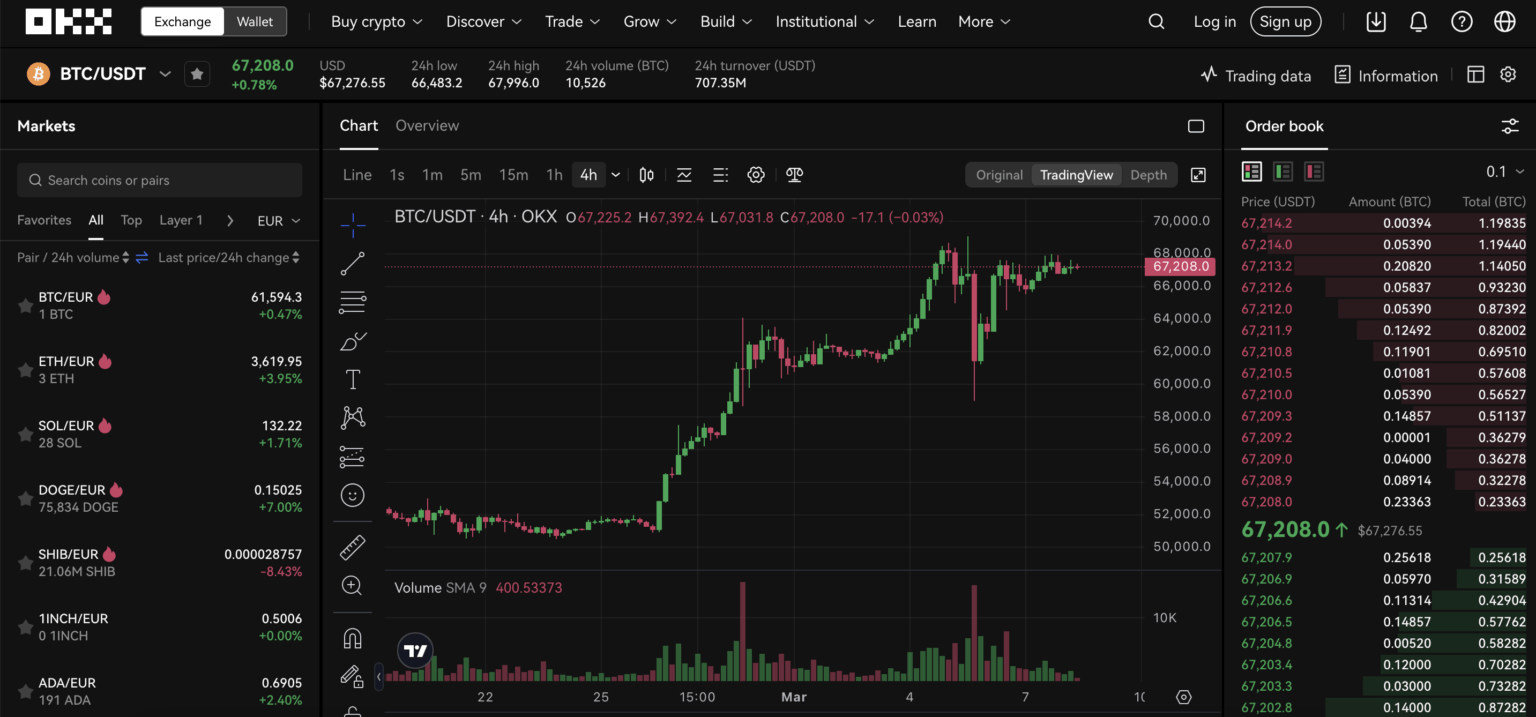
Spot trading is straightforward in principle — buying and selling assets at the current market price — but the operational details matter when you’re already signed in. OKX provides a full TradingView-based interface on web and mobile, plus charting, limit and market orders, and access to over 300 listed tokens and 130+ blockchains. The platform also supports margin trading up to 10x for those who want leverage, but this is not spot trading and carries materially different risk.
Here’s what to do once you sign in for a spot trade: confirm your session (check recent login history and device list), verify 2FA, move only the capital you intend to trade to the spot account (keep long-term holdings in cold storage or the non-custodial wallet), and set explicit order types and slippage limits. Avoid market orders on illiquid tokens; slippage and wide bid-ask spreads are real problems. The platform’s DEX aggregator can help find better swap routes for cross-chain or liquidity-poor tokens, but the aggregator adds smart-contract exposure if you use on-chain routes.
Common Misconceptions and Corrections (Myth-Busting)
Myth 1 — “If the exchange says it has cold storage, my assets are safe.” Correction: OKX keeps over 95% of assets in cold, multi-signature wallets, which substantially reduces hack risk at the custody layer. That reduces systemic custodial risk but does not protect you from phishing, account takeover, or social-engineering attacks targeting your login credentials or 2FA methods.
Myth 2 — “2FA is all I need.” Correction: 2FA is necessary but not sufficient. SMS 2FA can be bypassed via SIM swap. Use an authenticator app or hardware-based biometric where possible. Combine strong unique passwords, hardware wallets for large balances, and withdrawal whitelists to make an attacker’s job much harder.
Myth 3 — “Proof of Reserves means absolute solvency.” Correction: Proof of Reserves improves transparency by showing on-chain backing for customer assets, but PoR doesn’t prove ongoing liability management, operational health, or the absence of off-chain obligations. Treat PoR as a helpful signal, not a guarantee.
Security Trade-Offs: Custodial vs Self-Custodial on OKX
OKX offers both custodial accounts (standard CEX accounts) and a non-custodial Web3 wallet with seed phrases and hardware-wallet integration. The trade-off is classic: custodial convenience and built-in recovery options versus self-custodial control at the cost of absolute responsibility. For traders focused on spot trading frequency, custodial accounts paired with strong operational hygiene (2FA, whitelists, limited API keys, cold storage for reserves) are often practical. For long-term holdings or DeFi interactions, the non-custodial wallet with Ledger/Trezor and seed phrase discipline reduces counterparty risk but increases the chance of permanent loss if the seed is mismanaged.
Mechanically, the non-custodial wallet exposes you to smart contract and phishing risks when connecting to DApps; custodial accounts expose you to the exchange’s operational risk. Decide which risk you are better positioned to manage.
Practical How-To: Smart OKX Sign In Checklist for US Traders
Before signing in:
– Use a unique, high-entropy password manager to create and store your credentials.
– Prefer an authenticator app (Google Authenticator or hardware) over SMS.
– Update recovery contacts and enable withdrawal whitelists.
During sign-in:
– Confirm the domain and consider a browser extension that detects phishing sites.
– Review the session/device prompt; log out unfamiliar sessions immediately.
– Record the login time and check recent login history after signing in.
After sign-in:
– Move only active trading funds to the spot account; keep >90% in cold storage if you’re managing large balances.
– Use limit orders and pre-set slippage tolerance on thin markets.
– If you use API keys for bots, keep permissions minimal and whitelist IPs.
One useful habit: perform a “security dry run” every quarter — rotate keys, check KYC info, re-run authenticator setup — so that recovery paths are tested before an emergency.
Where This Can Break and What to Watch Next
OKX’s technical protections are strong, but the most actionable weaknesses are human and external: phishing, SIM swaps, poorly configured API keys, and social-engineering attacks. Regulatory shifts in the US can also change functionalities: stricter AML/KYC rules could increase onboarding friction or temporarily flag accounts during compliance updates. Monitor these signals: sudden changes to app permissions, new wallet integration announcements, or platformwide maintenance messages are meaningful. The recent app messaging that OKX is positioning as a money app underscores how exchanges are broadening services — that increases convenience but also the attack surface.
FAQ
How do I find the official OKX sign-in page safely?
Type the URL directly or use your saved bookmark. Never follow login links from email without checking the sender. You can also use the official mobile app, which supports biometric login; for web access, check TLS padlock and domain. For a reliable quick reference to the login flow, see this resource: okx login.
Is it safe to keep funds on OKX for spot trading?
It depends on time horizon and threat model. OKX stores most assets in cold, multi-signature vaults and uses PoR for transparency, which reduces custodial risk. For frequent spot trading, keeping a portion on exchange is practical; for long-term holdings, use hardware wallets or the non-custodial Web3 wallet. The right split depends on your liquidity needs and tolerance for counterparty risk.
What 2FA method should I choose?
Prefer an authenticator app or hardware-based authentication over SMS. Biometrics on mobile are convenient but tie you to device security—combine them with an authenticator app and a secure password. For large balances, consider adding a hardware wallet for withdrawal confirmations.
Can I use OKX’s DEX aggregator safely?
The aggregator finds liquidity routes across DEXs, which can reduce slippage. However, if you route on-chain, you expose yourself to smart contract and bridge risks. Use small test swaps on new tokens, verify contract addresses, and be cautious with tokens that have low liquidity or high rug risk.
Final Practical Takeaways
Signing in to OKX is governed by layered protections — strong engineering plus procedural controls — but the residual risks are human and external. Treat sign-in as a security-critical action: prepare before you log in, verify during the session, and compartmentalize assets after you log in. When trading spot, align your custody choice with your time horizon: keep trading liquidity accessible but safeguard the bulk of long-term value outside the hot environment.
One reusable heuristic: “short-term accessibility, long-term custody.” For active spot trading, keep only what you intend to use on the exchange; store the rest in hardware-anchored cold storage or the non-custodial OKX wallet. That framing clarifies trade-offs and makes operational decisions easier under stress.
Finally, remember that platform features evolve. OKX’s expansion as a broader money app and Web3 hub increases convenience and the surface for new risks. Watch for changes in app behavior, KYC flows, and withdrawal policies — those are the signals that should change how you manage sign-in, liquidity, and risk going forward.